
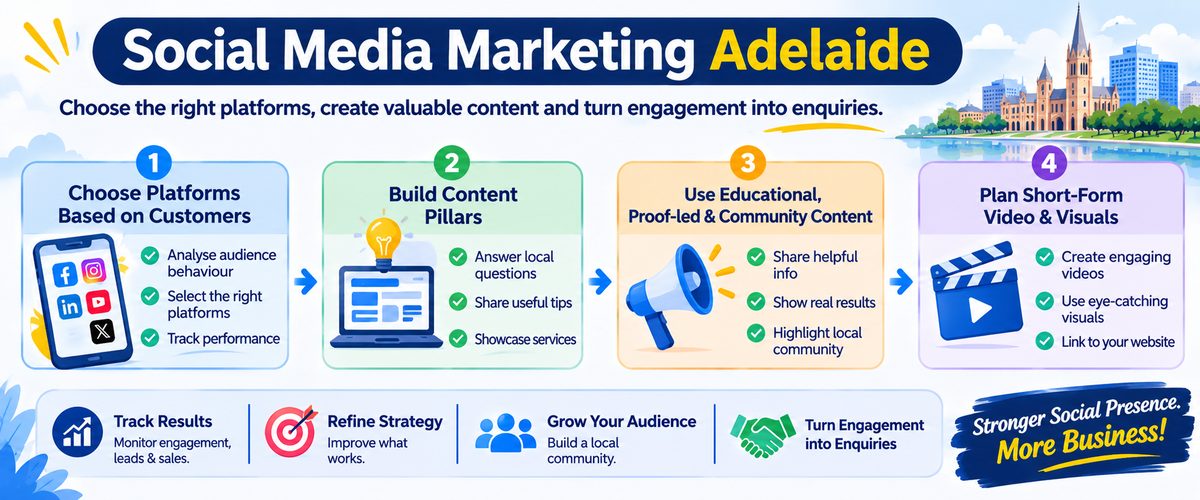
Choose platforms based on customer behaviour
For a business researching social media marketing Adelaide, the first step is to define the decision this part of the strategy needs to support. A local content planning guide showing how to select platforms, build useful content pillars and connect social engagement to enquiries.
Document the baseline, identify the pages or campaigns involved, and record what success would look like. This gives the team a reference point and makes later reporting more meaningful. It also helps separate a genuine improvement from normal fluctuations in demand, seasonality or competition.
Use analytics and Search Console data to understand which pages attract relevant visibility, what queries trigger impressions and where visitors take action. Combine quantitative data with sales feedback: the people handling enquiries often know which questions, objections and misunderstandings recur.
Build content pillars for local audiences
Audience-led platform and format choices
Plan posts with a defined audience question, message, format, link destination and follow-up action. Review responses with the sales team to identify content that should be expanded on the website.
Use educational, proof-led and community content
A useful approach is to review the current situation before choosing a tactic. A local content planning guide showing how to select platforms, build useful content pillars and connect social engagement to enquiries.
Use analytics and Search Console data to understand which pages attract relevant visibility, what queries trigger impressions and where visitors take action. Combine quantitative data with sales feedback: the people handling enquiries often know which questions, objections and misunderstandings recur.
Keep claims factual. Do not publish guaranteed rankings, invented customer results, unsupported cost averages or statements about a local office unless the business can substantiate them. Accurate detail helps users make decisions and supports long-term trust.
Plan short-form video and visual formats
The most reliable plan is based on evidence from customers, website behaviour and the actual search results. A local content planning guide showing how to select platforms, build useful content pillars and connect social engagement to enquiries.
Prioritise changes by likely business impact, confidence and effort. Fix issues that prevent important pages from being crawled or understood before spending time on minor cosmetic details. For content, improve usefulness and distinctiveness rather than adding paragraphs solely to increase length.
Review performance at a sensible interval. Look at relevant organic impressions and clicks, conversions, lead quality and sales outcomes where tracking permits. Rankings can be useful diagnostic signals, but they are not a substitute for qualified business results.
Content workflow and local relevance
Use paid social to extend suitable content
Implementation should be practical, measurable and consistent with the business’s real capabilities. A local content planning guide showing how to select platforms, build useful content pillars and connect social engagement to enquiries.
Keep claims factual. Do not publish guaranteed rankings, invented customer results, unsupported cost averages or statements about a local office unless the business can substantiate them. Accurate detail helps users make decisions and supports long-term trust.
Document the baseline, identify the pages or campaigns involved, and record what success would look like. This gives the team a reference point and makes later reporting more meaningful. It also helps separate a genuine improvement from normal fluctuations in demand, seasonality or competition.
Measure enquiries and learn from audience response
Do not treat this as an isolated SEO or advertising task. A local content planning guide showing how to select platforms, build useful content pillars and connect social engagement to enquiries.
Review performance at a sensible interval. Look at relevant organic impressions and clicks, conversions, lead quality and sales outcomes where tracking permits. Rankings can be useful diagnostic signals, but they are not a substitute for qualified business results.
The website and campaign message should answer the user’s immediate question. Explain the service, intended audience, process, limitations and next step in plain language. If the information is difficult to verify or understand, visitors may leave even when the page receives relevant impressions.
Turn your B2B marketing into a structured lead-generation process. C
Engagement, enquiries and learning
Plan Adelaide social content around local customer questions
Start by collecting questions from customers, sales conversations, reviews and service staff. These questions are a stronger basis for content than a calendar built only around generic awareness dates. Group topics into practical themes such as choosing a provider, understanding a process, preparing for a service, avoiding common mistakes and comparing options. Decide which themes are appropriate for short social posts and which deserve a more detailed website resource. The objective is to help the intended audience understand the business and make an informed next decision.
Use formats that fit the message and the resources available. A short video can demonstrate a real process, a carousel can explain several decision points, and a customer story can show how a problem was approached when the facts and permissions are verified. Local references should be genuine; do not imply a partnership, customer result or physical presence that does not exist. Include accessible captions, readable on-screen text and a clear next step. Repurpose an idea thoughtfully rather than publishing identical copy on every platform.
Measure whether content reaches the intended audience and supports a useful action. Track saves, shares, profile visits, tagged website sessions, enquiries and assisted conversions where possible. Review comments and direct messages for questions that should be answered publicly or added to the website. If a post performs well but generates irrelevant enquiries, refine its audience or call to action. Social media should support the wider customer journey, not be judged only by follower growth or posting frequency.
Connect social media publishing to website and sales activity
A social post should have a clear role in the wider customer journey. Some posts can build awareness, others can explain a service, answer an objection or encourage an enquiry. Decide whether the post should link to a service page, an article, an event registration or no external destination at all. When a link is used, make sure the landing page continues the same message and provides a useful next step. Avoid directing every post to the homepage regardless of the topic.
Use a consistent tracking approach for campaign links. Apply sensible UTM naming so that website sessions can be attributed to the right platform, campaign and content theme. Do not use different names for the same campaign across several posts. Where possible, connect website enquiries to lead outcomes and ask new customers how they first heard about the business. These methods will not capture every influence, but they provide a more useful picture than likes alone.
Use audience response to shape future content. Questions in comments and messages may reveal gaps in service explanations, while repeated saves or shares can indicate that a guide is useful. Share those findings with sales and customer service teams. A practical social media marketing Adelaide plan is not measured only by how often the business posts; it should help the organisation communicate clearly and support customer decisions.
Build a content bank from real Adelaide customer questions
Keep a running list of questions received by phone, email, social messages and in-person conversations. Group them by customer stage: learning about a problem, comparing options, preparing to buy and using the service. This creates a content bank grounded in real needs. Choose the format that best answers each question: a short post for a simple reminder, a carousel for a multi-step explanation, a video for a demonstration or a detailed article for a complex decision.
Before publishing, check that the answer is accurate and that the business can support the claims. Ask a service specialist to review technical details, and obtain permission before using a customer story or identifiable image. Use local references only when they genuinely add context. Each asset should have a clear call to action, but not every post needs to sell directly. Some content can build understanding and direct readers to a more detailed website resource.
Review the questions that continue to appear after content is published. If a post generates confusion, improve the explanation or create a more complete resource. If a topic produces useful enquiries, consider adding it to the website’s service or FAQ content. This process makes social media marketing Adelaide more responsive to customers and reduces the need to invent topics simply to maintain a posting schedule.
Set a content approval process for local social posts
Before a post is scheduled, confirm that the offer, service details, dates and contact route are current. Obtain approval for customer images, testimonials and identifiable project details. Check that location references are genuine and that the business can fulfil the advertised service. For time-sensitive offers, add an expiry date to the content calendar so that outdated promotions are removed promptly. A simple approval process protects the brand and prevents confusion.
Review the comments and messages after publication and route service questions to the right person. If a post creates repeated questions, update the caption or add a website FAQ. If a campaign receives complaints or attracts the wrong audience, pause and investigate rather than continuing to publish the same message. This makes social media a two-way communication channel and improves the quality of future content.
Review social messages and comments as a source of customer insight, not just engagement. Recurring questions can inform future posts, service-page improvements and FAQs that help customers before they contact the business.
Recommended action checklist
- Confirm the business objective and intended customer.
- Validate the search intent and review the current SERP before publishing.
- Make the article distinct from the target landing page and existing CONCAT blogs.
- Add factual examples, screenshots or expert commentary where available.
- Link naturally to the designated landing page and relevant service resources.
- Track organic visibility, engagement and qualified conversion outcomes.
FAQ
What digital marketing services does CONCAT offer?
Our best digital marketing services cover a full spectrum of growth-focused solutions, including SEO and content marketing, performance marketing across Google, Meta, and LinkedIn, social media and brand management, website design, development, and optimization, as well as detailed marketing analytics and reporting. We also offer lead generation and ecommerce/marketplace marketing for Amazon and Flipkart, delivered by specialist teams across India, the USA, MEA and Australia. Every campaign is planned and executed with a clear focus on ROI, driving meaningful conversions and measurable business outcomes.
What content should an Adelaide business post on social media?
Useful topics include customer questions, process explanations, service tips, genuine project updates, team expertise and community information that is relevant to the audience.
Should local businesses use video?
Use video when it helps demonstrate a process, answer a question or show a real product or service. Keep captions and on-screen text accessible and accurate.
How can social posts drive website traffic?
Link to a relevant service page or resource when it adds value, use consistent campaign tracking and make sure the landing page continues the message in the post.
How should social media success be measured?
Use metrics that match the objective, such as meaningful engagement, profile visits, tagged sessions, qualified enquiries and assisted conversions. Followers alone are not a business outcome.
Explore the relevant service with CONCAT. If your business is assessing its digital marketing or SEO priorities, contact CONCAT to discuss the website, audience and growth objectives.
We are here to answer your questions 24/7
Need A Consultation?
Have questions or need professional insight? Our consultation services are designed to provide you with the expert advice and tailored solutions you’re looking for. Whether you’re facing challenges in business, legal matters, or any other area, we’re here to help. Schedule a consultation today and take the first step toward solving your concerns with expert guidance.
Comments are closed