
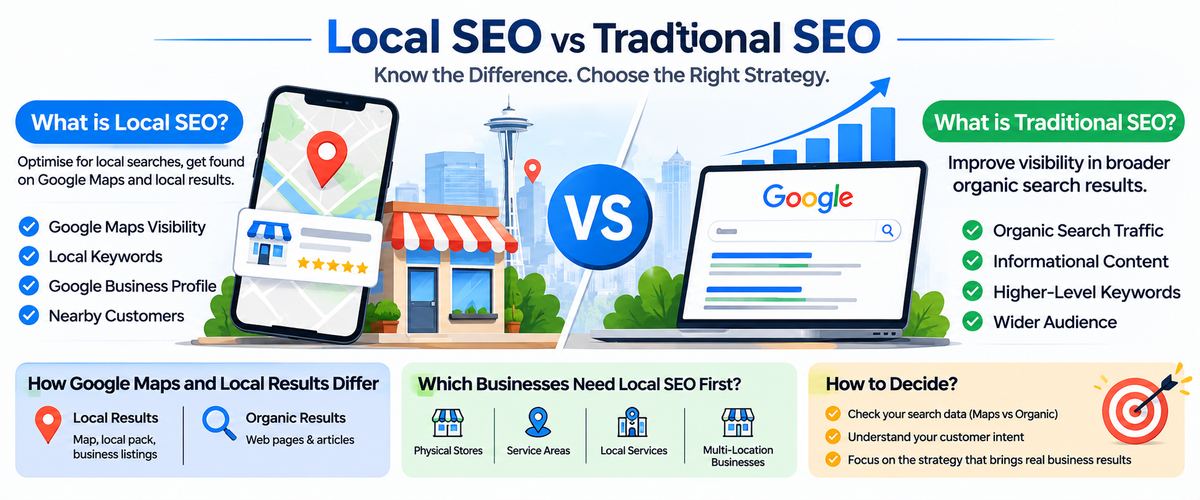
What is local SEO and what is traditional SEO?
For a business researching local SEO vs SEO Seattle, the first step is to define the decision this part of the strategy needs to support. A comparison explaining map/local intent versus broader organic search and how a business can decide which work to prioritise.
Document the baseline, identify the pages or campaigns involved, and record what success would look like. This gives the team a reference point and makes later reporting more meaningful. It also helps separate a genuine improvement from normal fluctuations in demand, seasonality or competition.
Use analytics and Search Console data to understand which pages attract relevant visibility, what queries trigger impressions and where visitors take action. Combine quantitative data with sales feedback: the people handling enquiries often know which questions, objections and misunderstandings recur.
How Google Maps and local results differ from organic listings
Local intent versus broader organic demand
Map each priority query to one intended URL and note how the profile, service page and supporting article connect. Review Search Console data before creating another location or service page.
Which businesses need local SEO first?
A useful approach is to review the current situation before choosing a tactic. A comparison explaining map/local intent versus broader organic search and how a business can decide which work to prioritise.
Use analytics and Search Console data to understand which pages attract relevant visibility, what queries trigger impressions and where visitors take action. Combine quantitative data with sales feedback: the people handling enquiries often know which questions, objections and misunderstandings recur.
Keep claims factual. Do not publish guaranteed rankings, invented customer results, unsupported cost averages or statements about a local office unless the business can substantiate them. Accurate detail helps users make decisions and supports long-term trust.
When broader SEO is essential
The most reliable plan is based on evidence from customers, website behaviour and the actual search results. A comparison explaining map/local intent versus broader organic search and how a business can decide which work to prioritise.
Prioritise changes by likely business impact, confidence and effort. Fix issues that prevent important pages from being crawled or understood before spending time on minor cosmetic details. For content, improve usefulness and distinctiveness rather than adding paragraphs solely to increase length.
Review performance at a sensible interval. Look at relevant organic impressions and clicks, conversions, lead quality and sales outcomes where tracking permits. Rankings can be useful diagnostic signals, but they are not a substitute for qualified business results.
Page roles and internal-link structure
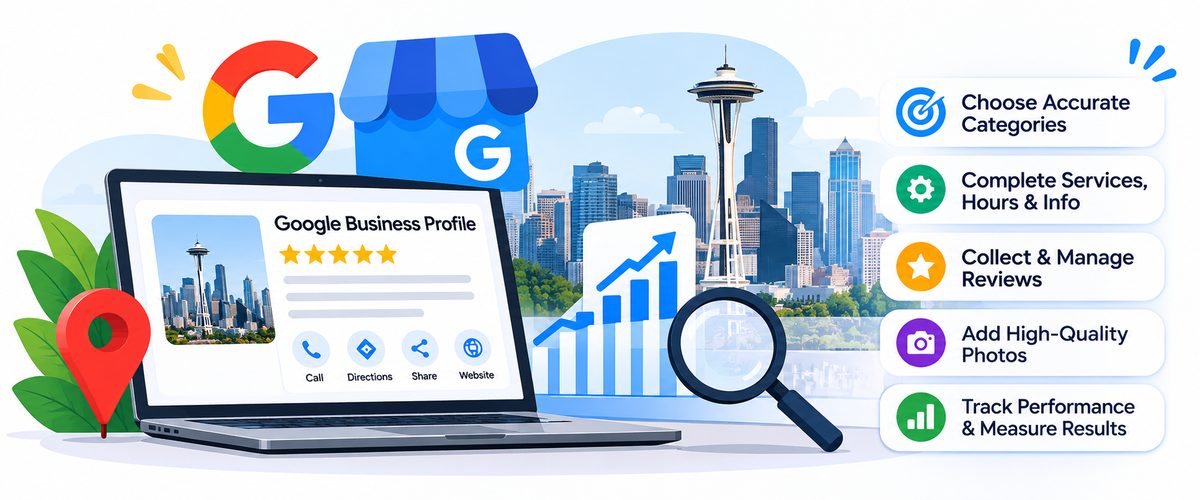
How website pages and Google Business Profile work together
Implementation should be practical, measurable and consistent with the business’s real capabilities. A comparison explaining map/local intent versus broader organic search and how a business can decide which work to prioritise.
Keep claims factual. Do not publish guaranteed rankings, invented customer results, unsupported cost averages or statements about a local office unless the business can substantiate them. Accurate detail helps users make decisions and supports long-term trust.
Document the baseline, identify the pages or campaigns involved, and record what success would look like. This gives the team a reference point and makes later reporting more meaningful. It also helps separate a genuine improvement from normal fluctuations in demand, seasonality or competition.
A combined local and organic SEO roadmap
Do not treat this as an isolated SEO or advertising task. A comparison explaining map/local intent versus broader organic search and how a business can decide which work to prioritise.
Review performance at a sensible interval. Look at relevant organic impressions and clicks, conversions, lead quality and sales outcomes where tracking permits. Rankings can be useful diagnostic signals, but they are not a substitute for qualified business results.
The website and campaign message should answer the user’s immediate question. Explain the service, intended audience, process, limitations and next step in plain language. If the information is difficult to verify or understand, visitors may leave even when the page receives relevant impressions.
Turn your B2B marketing into a structured lead-generation process. C
Separate measurement for local and organic
Decide how much local SEO and broader SEO your Seattle business needs
Local SEO is most important when customers choose a provider based on geographic proximity, service coverage or a nearby physical location. It includes accurate business information, an eligible Google Business Profile, local landing pages, genuine reviews and references that help customers understand where the business operates. Broader organic SEO is important when prospects search for expertise, products, detailed solutions or information that is not limited to a nearby provider. Many businesses need both, but the balance depends on how customers buy.
A service-area company may need a strong local presence and service pages that explain coverage without pretending to have offices in every neighbourhood. A software provider or specialist consultancy may rely more heavily on national or topic-based organic content, even if it has a Seattle office. Analyse Search Console queries, profile interactions, competitor results and enquiry records to identify the demand pattern. Do not assume that a high Maps ranking is the best outcome if most valuable customers search for specialist expertise outside the local pack.
Build a combined roadmap by assigning each page and asset a clear role. The Google Business Profile supports local discovery; the main service page explains the offer; supporting articles answer research questions; and relevant location pages clarify real coverage. Link these assets naturally and avoid creating near-identical pages for every suburb. Review local actions and organic conversions separately, then assess how the two workstreams contribute to qualified opportunities. This prevents local and traditional SEO from becoming competing budgets with no shared objective.
Avoid creating local pages that compete with each other
A Seattle business may have several service pages, location pages and educational resources, but each should serve a distinct purpose. Map the main search intent to the most appropriate URL and review whether two pages answer essentially the same question. If the same service is described on multiple thin pages with only a neighbourhood name changed, consider consolidating them or improving one stronger page. Keep redirects relevant and preserve useful content and links when making structural changes.
Use internal links to explain relationships between the pages. A location page can link to the core service page, while an educational guide can point to a relevant service when the reader is ready to compare providers. Anchor text should describe the destination naturally. Avoid forcing the exact same keyword into every internal link. Clear architecture helps users move through the site and makes the intended role of each page easier to understand.
Measure performance at URL level. Search Console can show which queries lead to which pages, while analytics and CRM data can reveal whether those visits become enquiries. If two pages alternate for the same query, investigate their intent, content and internal-link signals before changing either one. The objective is not to eliminate every overlap, but to ensure that each page provides a distinct reason to exist within the local SEO vs SEO Seattle strategy.
Use local and organic data to select the next SEO priority
Compare the search terms and pages that generate local profile actions with the queries bringing visitors to the website. A local business may find that customers search for a specific service plus a neighbourhood, while broader organic queries focus on a problem or solution. These are different intents and may need different page experiences. Review the actual result pages before changing the site so that the business understands whether Google is showing Maps, service pages, directories or educational content.
Prioritise pages that support real demand and can be improved meaningfully. A core service page may need clearer scope and stronger proof; a location page may need accurate coverage details; an educational guide may need a more direct answer and a useful internal link. Do not create several new pages simply because keyword tools show small location variations. Consolidate overlap where pages compete without offering distinct value.
Review both visibility and lead outcomes after changes. A page can gain impressions without generating suitable enquiries, while a profile can produce calls that are not recorded in website analytics. Use multiple data sources and note their limitations. This joined-up view helps a Seattle business decide how much effort to place into local SEO versus broader organic work.
Review local and organic performance separately
Use a separate scorecard for Maps visibility and broader organic search. Profile actions, direction requests and calls can help assess local discovery, while Search Console queries and organic landing-page conversions show how the wider website performs. The two data sets may overlap and may not attribute every customer interaction, so avoid adding them together as if they were unique leads. Record the measurement method and use actual enquiry records to add context where possible.
If local performance is strong but service-page traffic is weak, review the website’s content and internal links. If organic pages attract visitors but the profile receives few actions, check the business details and whether customers have a reason to visit or call. Prioritise the issue that most affects the customer’s next step. This keeps the local SEO vs SEO Seattle decision grounded in the business’s real acquisition journey.
Use the query and page map to decide which content should be improved before commissioning another location page. A clear role for each URL helps reduce overlap and makes internal links more meaningful.
Recommended action checklist
- Confirm the business objective and intended customer.
- Validate the search intent and review the current SERP before publishing.
- Make the article distinct from the target landing page and existing CONCAT blogs.
- Add factual examples, screenshots or expert commentary where available.
- Link naturally to the designated landing page and relevant service resources.
- Track organic visibility, engagement and qualified conversion outcomes.
FAQ
What digital marketing services does CONCAT offer?
Our best digital marketing services cover a full spectrum of growth-focused solutions, including SEO and content marketing, performance marketing across Google, Meta, and LinkedIn, social media and brand management, website design, development, and optimization, as well as detailed marketing analytics and reporting. We also offer lead generation and ecommerce/marketplace marketing for Amazon and Flipkart, delivered by specialist teams across India, the USA, MEA and Australia. Every campaign is planned and executed with a clear focus on ROI, driving meaningful conversions and measurable business outcomes.
What is the difference between local SEO and traditional SEO?
Local SEO focuses on geographic discovery, business profiles, service areas and local relevance. Traditional organic SEO targets broader informational or commercial searches that may not depend on proximity.
Does a Seattle business need both local and traditional SEO?
Many do. Local SEO supports customers choosing a nearby provider, while broader SEO can reach people researching expertise or solutions. The balance depends on the business model.
Can a service-area business rank in the local map results?
Eligible service-area businesses may appear in local results, but visibility depends on relevance, distance and prominence. Accurate profile setup does not guarantee a specific position.
Should every Seattle neighbourhood have its own SEO page?
Only when the business can provide distinct, useful information for that area. Pages that merely replace neighbourhood names in repeated copy can create thin content and overlap.
Explore the relevant service with CONCAT. If your business is assessing its digital marketing or SEO priorities, contact CONCAT to discuss the website, audience and growth objectives.
We are here to answer your questions 24/7
Need A Consultation?
Have questions or need professional insight? Our consultation services are designed to provide you with the expert advice and tailored solutions you’re looking for. Whether you’re facing challenges in business, legal matters, or any other area, we’re here to help. Schedule a consultation today and take the first step toward solving your concerns with expert guidance.
Comments are closed