
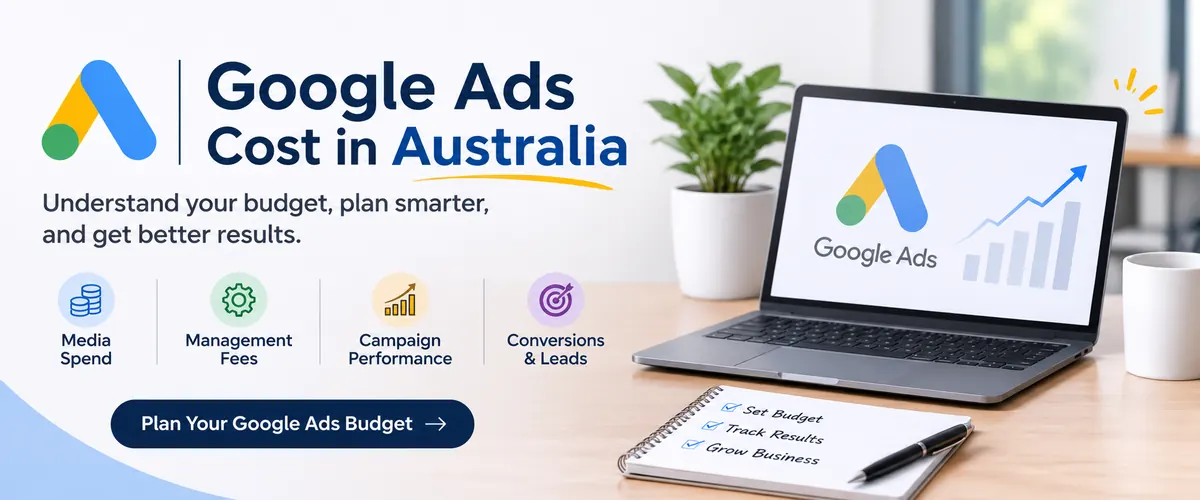
What does Google Ads actually cost in Australia?
For a business researching Google Ads cost Australia, the first step is to define the decision this part of the strategy needs to support. A practical Google Ads budget explainer separating media spend, management, landing-page work and conversion tracking; no unsupported CPC averages.
Document the baseline, identify the pages or campaigns involved, and record what success would look like. This gives the team a reference point and makes later reporting more meaningful. It also helps separate a genuine improvement from normal fluctuations in demand, seasonality or competition.
Use analytics and Search Console data to understand which pages attract relevant visibility, what queries trigger impressions and where visitors take action. Combine quantitative data with sales feedback: the people handling enquiries often know which questions, objections and misunderstandings recur.
The difference between ad spend and management fees
Forecasting clicks, conversions and qualified leads
Keep a campaign worksheet with the planned spend, target geography, conversion definition, search themes and test dates. Record why each setting was chosen and review the actual search terms before expanding the campaign.
What affects cost per click and cost per lead?
A useful approach is to review the current situation before choosing a tactic. A practical Google Ads budget explainer separating media spend, management, landing-page work and conversion tracking; no unsupported CPC averages.
Use analytics and Search Console data to understand which pages attract relevant visibility, what queries trigger impressions and where visitors take action. Combine quantitative data with sales feedback: the people handling enquiries often know which questions, objections and misunderstandings recur.
Keep claims factual. Do not publish guaranteed rankings, invented customer results, unsupported cost averages or statements about a local office unless the business can substantiate them. Accurate detail helps users make decisions and supports long-term trust.
How to calculate a starting budget from business economics
The most reliable plan is based on evidence from customers, website behaviour and the actual search results. A practical Google Ads budget explainer separating media spend, management, landing-page work and conversion tracking; no unsupported CPC averages.
Prioritise changes by likely business impact, confidence and effort. Fix issues that prevent important pages from being crawled or understood before spending time on minor cosmetic details. For content, improve usefulness and distinctiveness rather than adding paragraphs solely to increase length.
Review performance at a sensible interval. Look at relevant organic impressions and clicks, conversions, lead quality and sales outcomes where tracking permits. Rankings can be useful diagnostic signals, but they are not a substitute for qualified business results.
Campaign controls before launch
Why landing pages and conversion tracking affect cost
Implementation should be practical, measurable and consistent with the business’s real capabilities. A practical Google Ads budget explainer separating media spend, management, landing-page work and conversion tracking; no unsupported CPC averages.
Keep claims factual. Do not publish guaranteed rankings, invented customer results, unsupported cost averages or statements about a local office unless the business can substantiate them. Accurate detail helps users make decisions and supports long-term trust.
Document the baseline, identify the pages or campaigns involved, and record what success would look like. This gives the team a reference point and makes later reporting more meaningful. It also helps separate a genuine improvement from normal fluctuations in demand, seasonality or competition.
When to increase, reduce or restructure a campaign
Do not treat this as an isolated SEO or advertising task. A practical Google Ads budget explainer separating media spend, management, landing-page work and conversion tracking; no unsupported CPC averages.
Review performance at a sensible interval. Look at relevant organic impressions and clicks, conversions, lead quality and sales outcomes where tracking permits. Rankings can be useful diagnostic signals, but they are not a substitute for qualified business results.
The website and campaign message should answer the user’s immediate question. Explain the service, intended audience, process, limitations and next step in plain language. If the information is difficult to verify or understand, visitors may leave even when the page receives relevant impressions.
Search-term and lead-quality checks
Calculate a Google Ads test budget before launching
A useful starting budget can be modelled from the number of qualified leads the business wants to test, the expected click-to-lead conversion rate and a realistic planning cost per click gathered from the account or a controlled keyword forecast. Treat the forecast as an assumption, not a guarantee. If the business needs 20 qualified leads and expects only a portion of form submissions to qualify, the campaign must generate more than 20 raw conversions. Include the sales team’s capacity to respond and the time required to learn which searches produce viable customers.
Separate the media budget from campaign management, landing-page production, call tracking and creative costs. Decide whether the test will focus on one service, one geography or several tightly related themes. A narrow initial structure often makes it easier to understand search-term quality and avoid spreading a modest budget across too many campaigns. Set a daily cap that the business can sustain for the full learning period, and avoid changing bids, locations, ads and landing pages simultaneously unless a clear problem requires it.
Before launch, define what counts as a qualified conversion. A phone click is not necessarily a completed conversation, and a form submission may be outside the service area or unrelated to the offer. Where possible, return lead outcomes from the CRM or sales log to the advertising account. Review search terms, impression share, landing-page behaviour, call outcomes and cost per qualified lead together. If the budget is not generating enough evidence, refine the scope or improve conversion rate before simply increasing spend.
Use campaign structure to control Google Ads waste
Separate campaigns when the service, geography, budget or conversion objective is materially different. A business should not mix unrelated services in one campaign if doing so makes it difficult to control spend or interpret results. Keep ad groups focused on closely related search intent, and ensure that each group has a landing page that answers the query. Avoid creating dozens of tiny groups without enough traffic to learn; the structure should provide control without fragmenting the budget.
Check settings that can quietly change where the budget goes. Review location targeting options, language, networks, ad schedules, devices and bidding strategy. Confirm whether the campaign targets people physically present in the selected area or also people merely interested in it. For a local service, this distinction can affect lead relevance. Use search-term reports to identify irrelevant intent and add negative keywords carefully, checking that exclusions do not block legitimate variations or useful research terms.
Document the reason for every major change. If a campaign is moved to automated bidding, confirm that conversion tracking is reliable and that the account has enough meaningful conversion data for the strategy. If a budget is increased, note the expected additional volume and the point at which performance will be reviewed. This makes it easier to understand whether a change improved results or simply changed the mix of traffic.
Make the most of your advertising budget with a well-planned Google Ads strategy.
Use a staged launch and learning plan for paid search
A paid search launch should have a defined preparation phase, controlled test phase and scale decision. During preparation, verify conversion tracking, check landing pages, review service coverage and build a negative keyword starting list. During the test, avoid making frequent changes that prevent the account from collecting comparable data. Record the campaign’s intended audience, key search themes and the reasons for the chosen bidding approach. A campaign should not be considered ready simply because ads have been approved.
Set a weekly review for search-term relevance, budget pacing, ad disapprovals, location performance and conversion tracking. Do not optimise only for click-through rate: a highly engaging ad can still attract unsuitable visitors. Check whether the landing page repeats the service and location promise, answers likely objections and provides a working contact route. If call leads matter, listen to a suitable sample where lawful and appropriate, and record whether the conversations match the campaign’s objective.
At the end of the test, decide whether to scale, refine or pause. Scale only when the business has enough evidence that additional traffic can produce qualified leads at an acceptable cost. Refine when the audience is relevant but the offer or page needs work. Pause when the campaign repeatedly attracts irrelevant searches or the business cannot fulfil the demand. Document the decision so that future Google Ads cost Australia planning is based on learning rather than guesswork.
Check the landing page before increasing Google Ads spend
A campaign can be well targeted and still waste money if the destination page is unclear. Confirm that the headline reflects the search intent, the service is described accurately and the location coverage is easy to understand. Put the main contact action where mobile visitors can find it, reduce unnecessary form fields and explain what happens after submission. Check page speed and test the form and phone link on real devices. The landing page should answer the questions a prospect needs resolved before contacting the business.
Review the search terms and the page together. If people search for a specific service but land on a broad page, create a more relevant destination or refine the targeting. If visitors reach the page but do not enquire, use recordings or user feedback where appropriate to identify friction. Make one significant change at a time and monitor qualified conversions. Improving relevance and usability can be more valuable than raising bids to buy additional clicks.
Check that the campaign’s location and audience settings still reflect the business’s service capacity. Review them after staffing changes, seasonal demand or a change in operating hours. Accurate targeting protects the budget and reduces enquiries the team cannot fulfil.
Recommended action checklist
- Confirm the business objective and intended customer.
- Validate the search intent and review the current SERP before publishing.
- Make the article distinct from the target landing page and existing CONCAT blogs.
- Add factual examples, screenshots or expert commentary where available.
- Link naturally to the designated landing page and relevant service resources.
- Track organic visibility, engagement and qualified conversion outcomes.
FAQ
What digital marketing services does CONCAT offer?
Our best digital marketing services cover a full spectrum of growth-focused solutions, including SEO and content marketing, performance marketing across Google, Meta, and LinkedIn, social media and brand management, website design, development, and optimization, as well as detailed marketing analytics and reporting. We also offer lead generation and ecommerce/marketplace marketing for Amazon and Flipkart, delivered by specialist teams across India, the USA, MEA and Australia. Every campaign is planned and executed with a clear focus on ROI, driving meaningful conversions and measurable business outcomes.
How do I estimate a starting Google Ads budget?
Work backwards from the number of qualified leads required, expected conversion rate and a realistic click-cost assumption from account data or a forecast. Treat the result as a test budget, not a promise.
Is Google Ads spend paid directly to Google?
The media budget is charged by Google, while agency management, creative, landing-page development and tracking may be separate costs. Confirm billing and account ownership in the agreement.
Why can Google Ads generate clicks but few leads?
Why can Google Ads generate clicks but few leads?
How often should Google Ads campaigns be reviewed?
Check search-term relevance and budget pacing frequently during launch, then establish a regular review cadence. Evaluate qualified lead outcomes over a period that reflects the business’s sales cycle.
Explore the relevant service with CONCAT. If your business is assessing its digital marketing or SEO priorities, contact CONCAT to discuss the website, audience and growth objectives.
We are here to answer your questions 24/7
Need A Consultation?
Have questions or need professional insight? Our consultation services are designed to provide you with the expert advice and tailored solutions you’re looking for. Whether you’re facing challenges in business, legal matters, or any other area, we’re here to help. Schedule a consultation today and take the first step toward solving your concerns with expert guidance.

Comments are closed