
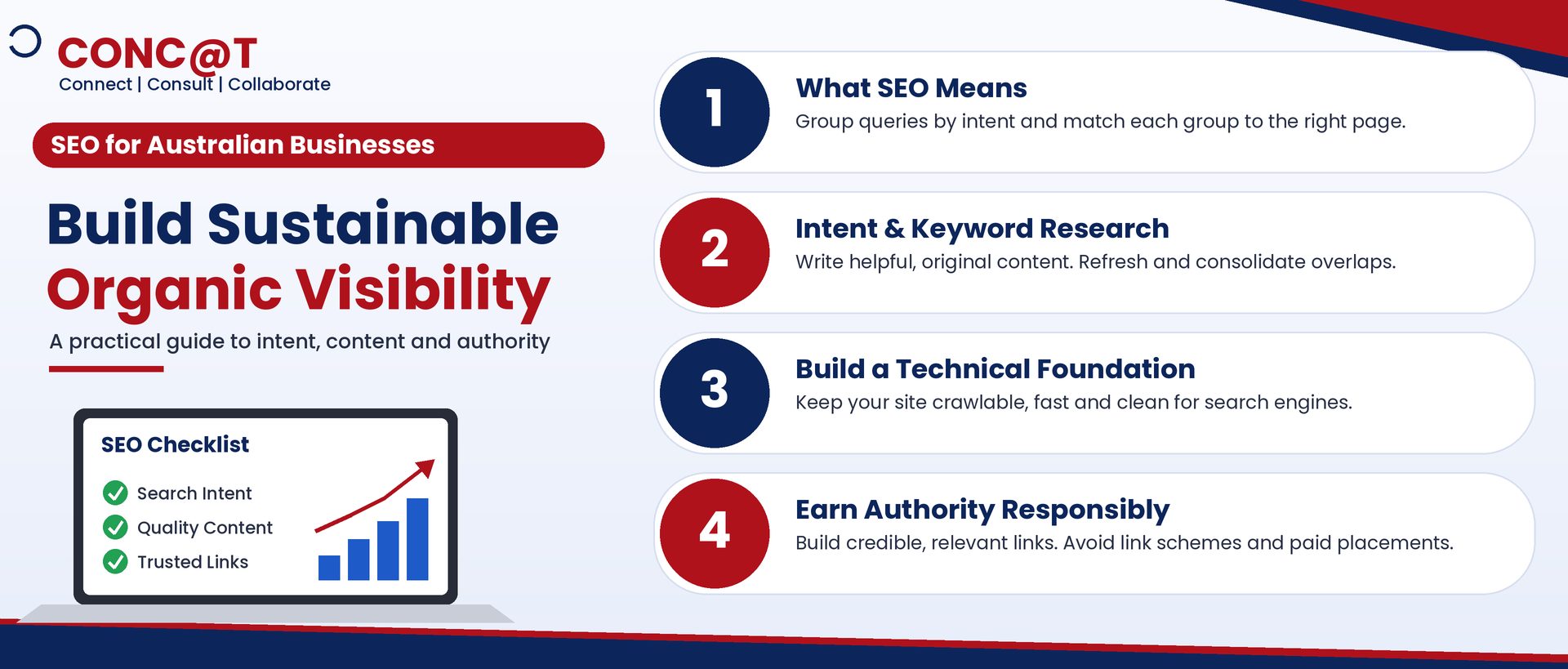
What SEO means for Australian businesses
What SEO means for Australian businesses is an important part of seo for australian businesses: a complete guide to building sustainable organic visibility. Group queries by intent and decide which page should satisfy each group.
A national service page may target broad commercial intent, while a city page may address local provider searches and a blog may answer a research question. This structure helps prevent several pages from competing with one another.
Use primary phrases naturally in titles, headings and copy where they accurately describe the page. Add synonyms and related concepts when they improve clarity. Avoid fixed keyword-density targets: relevance, completeness and readability matter more than repeating an exact phrase a predetermined number of times.
Start with search intent and keyword research
Start with search intent and keyword research is an important part of seo for australian businesses: a complete guide to building sustainable organic visibility. Helpful content explains decisions, trade-offs, processes and limitations. It should be written for the intended reader and reviewed for accuracy. Generic paragraphs that could appear on any competitor’s website add little value, even when they contain the target keyword.
Refresh content when services, platform behaviour or customer questions change. Consolidate overlapping articles, update outdated references and redirect pages only when there is a clear equivalent. A content audit should consider usefulness, organic performance, conversions and duplication.
Build a technically sound website
Build a technically sound website is an important part of seo for australian businesses: a complete guide to building sustainable organic visibility. Authority building should focus on credible references that make sense for the business and its industry. Useful assets, expert commentary, partnerships and genuinely valuable resources can create reasons for other sites to reference a page.
Avoid automated link schemes, irrelevant directory blasts and paid placements presented as editorial endorsements. Keep records of outreach and placements, review link quality and prioritise a natural profile that supports the brand rather than chasing a raw backlink count.
Create helpful service and informational content
Create helpful service and informational content is an important part of seo for australian businesses: a complete guide to building sustainable organic visibility. Group queries by intent and decide which page should satisfy each group. A national service page may target broad commercial intent, while a city page may address local provider searches and a blog may answer a research question. This structure helps prevent several pages from competing with one another.
Strengthen local and national relevance
Strengthen local and national relevance is an important part of seo for australian businesses: a complete guide to building sustainable organic visibility. Helpful content explains decisions, trade-offs, processes and limitations. It should be written for the intended reader and reviewed for accuracy. Generic paragraphs that could appear on any competitor’s website add little value, even when they contain the target keyword.
Earn authority through credible references
Earn authority through credible references is an important part of seo for australian businesses: a complete guide to building sustainable organic visibility. Authority building should focus on credible references that make sense for the business and its industry. Useful assets, expert commentary, partnerships and genuinely valuable resources can create reasons for other sites to reference a page.
Turn Your Marketing Insights Into Business Growth.
Measure SEO performance beyond rankings
Measure SEO performance beyond rankings is an important part of seo for australian businesses: a complete guide to building sustainable organic visibility. Group queries by intent and decide which page should satisfy each group. A national service page may target broad commercial intent, while a city page may address local provider searches and a blog may answer a research question. This structure helps prevent several pages from competing with one another.
Build a realistic SEO roadmap
Build a realistic SEO roadmap is an important part of seo for australian businesses: a complete guide to building sustainable organic visibility. Helpful content explains decisions, trade-offs, processes and limitations. It should be written for the intended reader and reviewed for accuracy. Generic paragraphs that could appear on any competitor’s website add little value, even when they contain the target keyword.
How to select an SEO partner
How to select an SEO partner is an important part of seo for australian businesses: a complete guide to building sustainable organic visibility. Authority building should focus on credible references that make sense for the business and its industry. Useful assets, expert commentary, partnerships and genuinely valuable resources can create reasons for other sites to reference a page.
Map Australian SEO work to a page-level roadmap
A national SEO programme should not begin with a long list of keywords. Start by mapping services, customer groups and search intent to the pages that can satisfy them. A broad service page may target national commercial demand, a location page may address genuine local availability and an article may answer a research question. Give each important URL a clear purpose. If two pages target the same audience and intent, decide whether one should be consolidated, differentiated or redirected after checking performance and relevance.
Prioritise technical and content work according to the size of the opportunity and the risk involved. Important service pages that are blocked from indexing, have weak internal links or fail to explain the offer deserve attention before minor wording changes. Similarly, a page with impressions but poor click-through may need a clearer title and description, while a page with relevant visits but few enquiries may need better content or conversion paths. Search Console, analytics and lead records should be read together.
Create a roadmap with separate workstreams for technical health, page optimisation, content development, internal linking and authority. Each task should include the affected URLs, reason for the change, owner, dependency and success measure. This is especially important for larger sites where a template change can affect hundreds of pages. Keep a change log so that performance movement can be compared with releases and content updates.
Review the roadmap regularly, but do not change priorities solely because a keyword moves a few positions. Look for sustained patterns in relevant impressions, clicks, landing-page engagement and qualified conversions. Search demand, competition and seasonality can all influence results. A realistic SEO plan balances near-term corrections with work that improves the site’s ability to earn useful organic visibility over time.
Separate national and local keyword targets before optimisation
A national SEO page and a local landing page may discuss the same service, but they should answer different search needs. The national page can explain the broader service offering, industries served and delivery model. A location page should explain genuine availability and local considerations. An article can address a specific research question. Map those purposes before changing titles or adding new URLs. If two pages have similar intent, decide which one should be the primary destination and whether the other needs a narrower purpose.
Use Search Console to review the queries each URL is already receiving. If multiple pages appear for the same query group, inspect their content, internal links and conversion role before taking action. Sometimes the pages serve different needs and should remain separate; in other cases, one page may be too thin or too similar to another. Avoid changing URLs or adding redirects without checking backlinks, traffic history and the closest relevant replacement. A documented keyword map reduces accidental cannibalisation and makes future content planning more disciplined.
Create an SEO programme that connects technical work and content
An SEO programme becomes easier to manage when technical improvements and content decisions are planned together. A page may be well written but difficult to discover because internal links are weak or the site structure hides it. A technically accessible page may still fail to earn visibility if it does not answer the searcher’s question. Review each priority URL from both perspectives: can search engines access and interpret it, and does the content give the intended audience a complete, credible answer? This page-level view prevents technical audits and content plans from becoming separate lists with no shared priorities.
For every important service or topic, identify the target query group, the intended page, the supporting content and the internal links that connect them. Check whether the page has a clear title, useful headings, original information and a logical next action. Then confirm that the URL is indexable, returns the expected status code, has an appropriate canonical and can be reached through relevant internal links. If a page is not performing, diagnose whether the constraint is demand, relevance, technical access, content quality or conversion rather than assuming that more content is always the answer.
Keep keyword mapping aligned with website architecture
A keyword map should be reviewed whenever services, navigation or URL structures change. New pages can create overlap with existing content, and renamed URLs can leave internal links pointing to outdated destinations. Keep a record of the primary intent, target URL, supporting queries and relevant internal links for each priority page. When a new article is proposed, check whether it answers a distinct question or competes with an existing service page. This small governance step reduces accidental cannibalisation and makes it easier for writers, developers and SEO specialists to work from the same plan. Revisit the map after migrations, service launches and major content consolidations.
National SEO roadmap checks
- Map keyword groups to distinct service, location and informational pages.
- Prioritise technical issues affecting valuable URLs and templates.
- Set separate workstreams for content, internal links and authority.
- Record owners, dependencies, affected URLs and success measures.
- Review sustained search and conversion trends before changing direction.
Businesses planning a broader organic programme can review CONCAT’s SEO services information to understand the related service scope.
FAQ
What digital marketing services does CONCAT offer?
Our best digital marketing services cover a full spectrum of growth-focused solutions, including SEO and content marketing, performance marketing across Google, Meta, and LinkedIn, social media and brand management, website design, development, and optimization, as well as detailed marketing analytics and reporting. We also offer lead generation and ecommerce/marketplace marketing for Amazon and Flipkart, delivered by specialist teams across India, the USA, MEA and Australia. Every campaign is planned and executed with a clear focus on ROI, driving meaningful conversions and measurable business outcomes.
What is the difference between technical SEO, on-page SEO and off-page SEO?
Technical SEO helps search engines access, crawl and understand a website. On-page SEO improves the content and page elements that satisfy search intent. Off-page SEO concerns signals and references from other sites and relevant online sources. A sustainable programme considers all three.
How should an Australian business choose keywords for national SEO?
Map keywords to services, audience needs and search intent across the country. Consider regional language and genuine service coverage, assess competition and demand, and assign one clear primary intent to each important page to reduce cannibalisation.
Does publishing more blog posts automatically improve organic rankings?
No. Content needs to satisfy a real user need, be accurate and fit the site’s topical and commercial purpose. More pages can create maintenance and duplication problems if they do not add distinct value or have a clear place in the site architecture.
How can a business measure SEO beyond keyword positions?
Review indexation, impressions, clicks, organic landing-page engagement, conversions, qualified leads and revenue where measurable. Rankings can help diagnose visibility changes, but they should be interpreted alongside search demand and business outcomes.
When should an Australian website consider an SEO audit?
An audit is useful before a major redesign, after a migration, when organic performance changes unexpectedly or when the site has grown enough to create structural complexity. It should prioritise issues by impact and effort rather than produce an undifferentiated list.
Plan your next step with CONCAT. Businesses evaluating their digital growth priorities can contact CONCAT to discuss their objectives, current website and the support that may be appropriate.
We are here to answer your questions 24/7
Need A Consultation?
Have questions or need professional insight? Our consultation services are designed to provide you with the expert advice and tailored solutions you’re looking for. Whether you’re facing challenges in business, legal matters, or any other area, we’re here to help. Schedule a consultation today and take the first step toward solving your concerns with expert guidance.
Comments are closed