
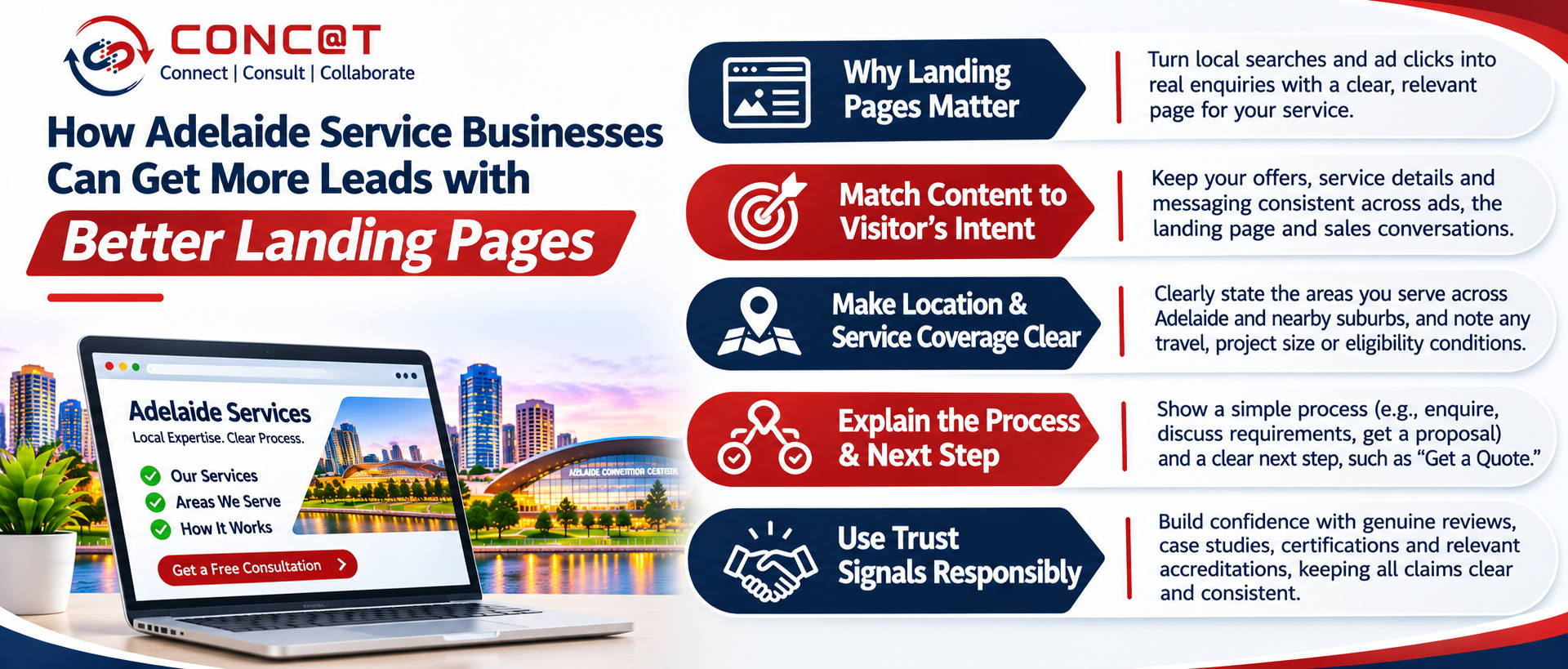
Why landing pages matter for local services
Why landing pages matter for local services is an important part of how adelaide service businesses can improve website leads with better landing pages. Explain what the business does, who it helps and which parts of Adelaide or surrounding areas it serves. Visitors should not have to infer whether a service is available to them. Where coverage depends on project size, travel or eligibility, describe those details clearly.
Match page content to the visitor’s intent
Match page content to the visitor’s intent is an important part of how adelaide service businesses can improve website leads with better landing pages. The promise made in an advertisement or social post should be carried through to the landing page and the first sales conversation. Inconsistent offers or unclear service details can reduce trust and make performance difficult to interpret.
Make location and service coverage clear
Make location and service coverage clear is an important part of how adelaide service businesses can improve website leads with better landing pages. Sales conversations and customer reviews can reveal the language customers use, the features they value and the concerns that need to be answered. With appropriate permission, anonymised themes can inform FAQs, service explanations and educational content.
Explain the process and expected next step
Explain the process and expected next step is an important part of how adelaide service businesses can improve website leads with better landing pages. Explain what the business does, who it helps and which parts of Adelaide or surrounding areas it serves. Visitors should not have to infer whether a service is available to them. Where coverage depends on project size, travel or eligibility, describe those details clearly.
Use trust signals responsibly
Use trust signals responsibly is an important part of how adelaide service businesses can improve website leads with better landing pages. The promise made in an advertisement or social post should be carried through to the landing page and the first sales conversation. Inconsistent offers or unclear service details can reduce trust and make performance difficult to interpret.
Reduce form friction
Reduce form friction is an important part of how adelaide service businesses can improve website leads with better landing pages. Sales conversations and customer reviews can reveal the language customers use, the features they value and the concerns that need to be answered. With appropriate permission, anonymised themes can inform FAQs, service explanations and educational content.
Improve mobile experience and speed
Improve mobile experience and speed is an important part of how adelaide service businesses can improve website leads with better landing pages. Explain what the business does, who it helps and which parts of Adelaide or surrounding areas it serves. Visitors should not have to infer whether a service is available to them. Where coverage depends on project size, travel or eligibility, describe those details clearly.
Turn Your Marketing Insights Into Business Growth.
Measure and refine conversion performance
Measure and refine conversion performance is an important part of how adelaide service businesses can improve website leads with better landing pages. The promise made in an advertisement or social post should be carried through to the landing page and the first sales conversation. Inconsistent offers or unclear service details can reduce trust and make performance difficult to interpret.
Improve Adelaide landing pages for better enquiry quality
A landing page should answer the questions that determine whether a visitor is ready to contact the business. For a local service, those questions often include whether the provider offers the required service, whether the visitor’s location is covered, what the process involves, what information is needed and how soon a response can be expected. Put those answers in a logical order. A page that hides service boundaries or makes the visitor search for basic details may generate fewer suitable enquiries even if it receives substantial traffic.
Build the page around one primary service and one main action. If the business offers several distinct services, use separate pages when the audience, scope and search intent differ enough to justify them. Avoid creating a separate page for every keyword variation. Each page should provide information that is genuinely useful for that service, such as deliverables, typical stages, relevant considerations, eligibility or preparation steps. Where the business cannot publish prices, explain the factors that influence a quote and what information is needed to provide one.
Use evidence carefully. Genuine reviews, staff credentials, process explanations, guarantees that the business can honour and clear contact information can reduce uncertainty. Do not add invented testimonials, stock project photos presented as completed work or claims that cannot be substantiated. If the business has limited case-study material, explain the method and standards customers can expect rather than manufacturing results.
Test the page on mobile and check every conversion route. Forms should request only information needed for the next step; phone links should work; labels and error messages should be clear; and confirmation screens should set expectations. Track form starts, successful submissions, calls and qualified enquiries where possible. A higher conversion rate is not automatically an improvement if the page encourages unsuitable contacts. The objective is a clearer decision and a better-quality enquiry.
Use a landing-page outline before writing the full page
A simple page outline can prevent important information from being buried. Start with the service and intended customer, then explain the problem addressed, what is included, who the service is suitable for and where it is available. Follow with the process, relevant proof, answers to common objections and one clear contact action. The order may change according to the search intent, but the page should not make visitors work to discover basic eligibility or service details.
Review the outline with the person who delivers the service before writing polished copy. Ask whether the promised scope is accurate, whether any conditions are missing and what information the team needs before giving a quote or booking. This avoids publishing marketing language that operations cannot support. Once the page is live, compare the search query and advertisement that brought the visitor with the content they see. If the page answers a different question, adjust the message or the destination rather than adding more calls to action.
Use page-level evidence to improve Adelaide enquiry journeys
Review the path a visitor takes from the search result to the enquiry confirmation. The title and description should set an accurate expectation, the landing page should continue that message and the form should ask for information relevant to the next conversation. If the page promises a specific service but the form offers only a generic contact option, the transition may feel unclear. Use event tracking to identify where visitors interact, but also test the journey manually on different devices.
After a change, compare more than the number of submissions. Check whether enquiries contain the details the team needs, whether response times remain acceptable and whether more prospects progress to the next stage. If a shorter form increases volume but reduces lead quality, consider adding one carefully chosen qualifying question or improving the explanatory copy. Keep a record of the previous version, the change and the review date. This turns landing-page optimisation into a measured process rather than a sequence of cosmetic edits.
Use a page brief to prevent thin landing-page copy
A landing-page brief should specify the search intent, service scope, intended customer, geographic coverage, proof available, common objections and conversion action. It should also list claims that need approval and information the business cannot promise. Writers can then produce a page that answers the right questions without inventing project examples or adding generic paragraphs to reach a target length. Ask a subject-matter reviewer to confirm accuracy before publication. The page should be as long as needed to support the decision, not longer simply to meet a word count. Useful detail, clear structure and trustworthy evidence matter more than padding. A clear brief also makes it easier to compare the finished page with the original search intent.
Check page accuracy with the service team
Before publication, ask the people delivering the service to review the page for scope, availability, terminology and any conditions that affect a quote or booking. They may identify practical details that a writer or marketer would not know, such as preparation required from the customer or information needed before an estimate can be provided. Add only the details that help a visitor make an informed decision. This review protects the business from promising an experience that operations cannot deliver and helps the page attract enquiries that are more likely to progress.
Landing-page quality checks
- Give each page one primary service intent and one main action.
- Explain scope, coverage, process and quote requirements clearly.
- Use only genuine reviews, credentials and project evidence.
- Keep forms short and test every mobile conversion route.
- Review lead suitability before treating a conversion-rate lift as success.
Landing-page work can be prioritised alongside the wider digital marketing services programme when traffic quality and conversion need joint attention.
FAQ
What digital marketing services does CONCAT offer?
Our best digital marketing services cover a full spectrum of growth-focused solutions, including SEO and content marketing, performance marketing across Google, Meta, and LinkedIn, social media and brand management, website design, development, and optimization, as well as detailed marketing analytics and reporting. We also offer lead generation and ecommerce/marketplace marketing for Amazon and Flipkart, delivered by specialist teams across India, the USA, MEA and Australia. Every campaign is planned and executed with a clear focus on ROI, driving meaningful conversions and measurable business outcomes.
What should an Adelaide landing page say above the fold?
The first screen should identify the service, intended customer and location or coverage where relevant. It should communicate a clear reason to continue and offer a visible next step, without forcing visitors to scroll to understand what the business does.
Should a landing page show prices?
Show prices or indicative ranges when they are stable, meaningful and help customers qualify themselves. If pricing depends on scope, explain the main cost factors and offer a clear way to request an assessment rather than using vague claims.
How many fields should an enquiry form contain?
Ask only for information needed to respond or qualify the request. A simple initial form may need name, contact method and a short description; more complex services may justify additional fields if each one has a clear purpose.
How can testimonials improve a service landing page?
Use genuine, permissioned feedback that is relevant to the service being promoted. Include enough context for readers to understand the customer’s experience, and do not edit testimonials in a way that changes their meaning.
What should be checked before publishing a new landing page?
Check mobile layout, load performance, headings, page title and description, internal links, form delivery, phone links, analytics events, indexability and the accuracy of every claim. Test the complete enquiry journey, not just the page design.
Plan your next step with CONCAT. Businesses evaluating their digital growth priorities can contact CONCAT to discuss their objectives, current website and the support that may be appropriate.
We are here to answer your questions 24/7
Need A Consultation?
Have questions or need professional insight? Our consultation services are designed to provide you with the expert advice and tailored solutions you’re looking for. Whether you’re facing challenges in business, legal matters, or any other area, we’re here to help. Schedule a consultation today and take the first step toward solving your concerns with expert guidance.
Comments are closed