
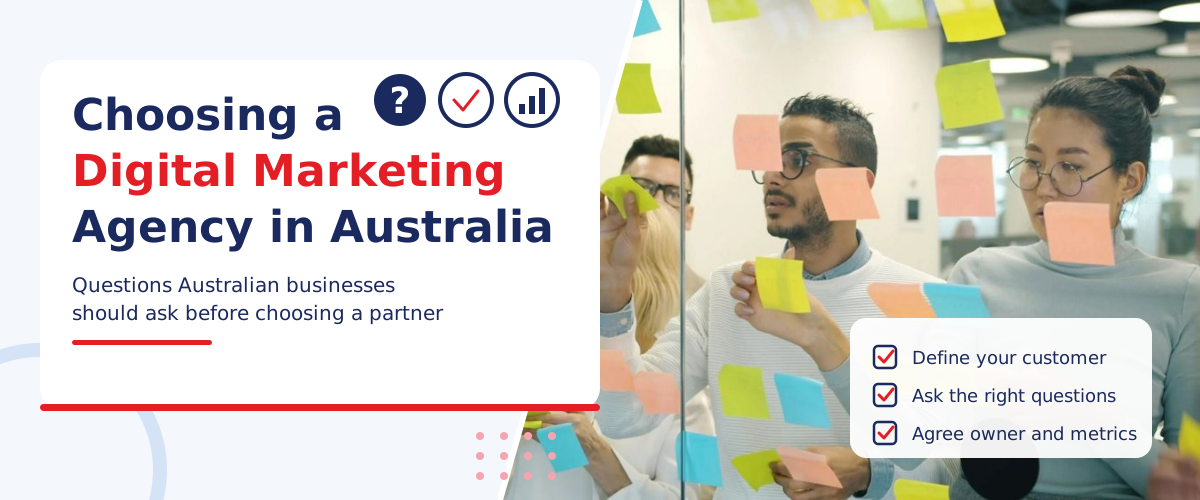
Why choosing an agency is a business decision
Why choosing an agency is a business decision is an important part of how to choose a digital marketing agency in australia: questions businesses should ask. Build a simple customer profile from existing enquiries, sales conversations, customer feedback and analytics.
Record the problem customers are trying to solve, the alternatives they consider, the language they use and the objections that delay a decision. This research provides a more reliable starting point than copying a competitor’s channel mix.
For Australian businesses comparing agency partners and wanting a transparent, commercially grounded selection process, the practical test is whether this work makes the next customer decision easier. Then map the buying journey. Some customers know exactly what service they need and search for a provider; others are still learning about the problem. Search pages, educational articles, comparison content and remarketing can support different stages, but the message should remain consistent.
A practical way to begin is to document the current position, identify the highest-value gap and assign an owner. Record the page, campaign or process being changed, the reason for the change, the metric expected to move and the review date. This simple record prevents teams from making several changes at once and then guessing which one influenced performance.
Start with objectives and commercial fit
Start with objectives and commercial fit is an important part of how to choose a digital marketing agency in australia: questions businesses should ask. Campaigns need a destination that answers the visitor’s question. A service page should explain scope, suitability, process, evidence and the next step. A blog should provide genuinely useful detail and link to the relevant commercial page only when the connection is natural.
For Australian businesses comparing agency partners and wanting a transparent, commercially grounded selection process, the practical test is whether this work makes the next customer decision easier. Review mobile usability, page speed, navigation, forms and contact options. Track important actions such as calls, form submissions and booked consultations. If possible, connect those actions to lead status so the team can distinguish a high-volume campaign from one that attracts qualified prospects.
The work should be reviewed in context rather than judged from a single metric. A rise in visits is useful only when those visits are relevant; a lower cost per click is not automatically positive if enquiry quality declines. Compare results with the original objective and use qualitative feedback from customers and the sales team to understand what the numbers cannot explain.
Evaluate strategy, not just a service list
Evaluate strategy, not just a service list is an important part of how to choose a digital marketing agency in australia: questions businesses should ask. A useful report explains what changed, why it may have changed and what action follows. Include visibility and traffic measures, but interpret them alongside conversion rate, lead quality and sales feedback. Segment performance by service, location, device and channel where the data is sufficient.
For Australian businesses comparing agency partners and wanting a transparent, commercially grounded selection process, the practical test is whether this work makes the next customer decision easier. Set a regular review cycle. Identify one or two meaningful improvements, assign an owner and check the outcome after enough data has accumulated. This creates a learning process rather than a sequence of disconnected campaigns.
Keep the experience consistent across the website, campaigns and follow-up. The language used in a search result or advertisement should match the destination page, and the next step should be clear. This alignment reduces confusion, supports trust and gives analytics a more meaningful conversion path to measure.
Check SEO, paid media and content capability
Check SEO, paid media and content capability is an important part of how to choose a digital marketing agency in australia: questions businesses should ask. Build a simple customer profile from existing enquiries, sales conversations, customer feedback and analytics. Record the problem customers are trying to solve, the alternatives they consider, the language they use and the objections that delay a decision. This research provides a more reliable starting point than copying a competitor’s channel mix.
For Australian businesses comparing agency partners and wanting a transparent, commercially grounded selection process, the practical test is whether this work makes the next customer decision easier. Then map the buying journey. Some customers know exactly what service they need and search for a provider; others are still learning about the problem. Search pages, educational articles, comparison content and remarketing can support different stages, but the message should remain consistent.
A practical way to begin is to document the current position, identify the highest-value gap and assign an owner. Record the page, campaign or process being changed, the reason for the change, the metric expected to move and the review date. This simple record prevents teams from making several changes at once and then guessing which one influenced performance.
Let's Take Your Australian Business to the Next Level!
Understand reporting and measurement
Understand reporting and measurement is an important part of how to choose a digital marketing agency in australia: questions businesses should ask. Campaigns need a destination that answers the visitor’s question. A service page should explain scope, suitability, process, evidence and the next step. A blog should provide genuinely useful detail and link to the relevant commercial page only when the connection is natural.
For Australian businesses comparing agency partners and wanting a transparent, commercially grounded selection process, the practical test is whether this work makes the next customer decision easier. Review mobile usability, page speed, navigation, forms and contact options. Track important actions such as calls, form submissions and booked consultations. If possible, connect those actions to lead status so the team can distinguish a high-volume campaign from one that attracts qualified prospects.
The work should be reviewed in context rather than judged from a single metric. A rise in visits is useful only when those visits are relevant; a lower cost per click is not automatically positive if enquiry quality declines. Compare results with the original objective and use qualitative feedback from customers and the sales team to understand what the numbers cannot explain.
Assess communication and account management
Assess communication and account management is an important part of how to choose a digital marketing agency in australia: questions businesses should ask. A useful report explains what changed, why it may have changed and what action follows. Include visibility and traffic measures, but interpret them alongside conversion rate, lead quality and sales feedback. Segment performance by service, location, device and channel where the data is sufficient.
For Australian businesses comparing agency partners and wanting a transparent, commercially grounded selection process, the practical test is whether this work makes the next customer decision easier. Set a regular review cycle. Identify one or two meaningful improvements, assign an owner and check the outcome after enough data has accumulated. This creates a learning process rather than a sequence of disconnected campaigns.
Keep the experience consistent across the website, campaigns and follow-up. The language used in a search result or advertisement should match the destination page, and the next step should be clear. This alignment reduces confusion, supports trust and gives analytics a more meaningful conversion path to measure.
Review proposals, scope and expectations
Review proposals, scope and expectations is an important part of how to choose a digital marketing agency in australia: questions businesses should ask. Build a simple customer profile from existing enquiries, sales conversations, customer feedback and analytics. Record the problem customers are trying to solve, the alternatives they consider, the language they use and the objections that delay a decision. This research provides a more reliable starting point than copying a competitor’s channel mix.
For Australian businesses comparing agency partners and wanting a transparent, commercially grounded selection process, the practical test is whether this work makes the next customer decision easier. Then map the buying journey. Some customers know exactly what service they need and search for a provider; others are still learning about the problem. Search pages, educational articles, comparison content and remarketing can support different stages, but the message should remain consistent.
A practical way to begin is to document the current position, identify the highest-value gap and assign an owner. Record the page, campaign or process being changed, the reason for the change, the metric expected to move and the review date. This simple record prevents teams from making several changes at once and then guessing which one influenced performance.
Questions to ask before signing
Questions to ask before signing is an important part of how to choose a digital marketing agency in australia: questions businesses should ask. Campaigns need a destination that answers the visitor’s question. A service page should explain scope, suitability, process, evidence and the next step. A blog should provide genuinely useful detail and link to the relevant commercial page only when the connection is natural.
For Australian businesses comparing agency partners and wanting a transparent, commercially grounded selection process, the practical test is whether this work makes the next customer decision easier. Review mobile usability, page speed, navigation, forms and contact options. Track important actions such as calls, form submissions and booked consultations. If possible, connect those actions to lead status so the team can distinguish a high-volume campaign from one that attracts qualified prospects.
The work should be reviewed in context rather than judged from a single metric. A rise in visits is useful only when those visits are relevant; a lower cost per click is not automatically positive if enquiry quality declines. Compare results with the original objective and use qualitative feedback from customers and the sales team to understand what the numbers cannot explain.
Warning signs to look out for
Warning signs to look out for is an important part of how to choose a digital marketing agency in australia: questions businesses should ask. A useful report explains what changed, why it may have changed and what action follows. Include visibility and traffic measures, but interpret them alongside conversion rate, lead quality and sales feedback. Segment performance by service, location, device and channel where the data is sufficient.
For Australian businesses comparing agency partners and wanting a transparent, commercially grounded selection process, the practical test is whether this work makes the next customer decision easier. Set a regular review cycle. Identify one or two meaningful improvements, assign an owner and check the outcome after enough data has accumulated. This creates a learning process rather than a sequence of disconnected campaigns.
Keep the experience consistent across the website, campaigns and follow-up. The language used in a search result or advertisement should match the destination page, and the next step should be clear. This alignment reduces confusion, supports trust and gives analytics a more meaningful conversion path to measure.
Building a productive agency relationship
Building a productive agency relationship is an important part of how to choose a digital marketing agency in australia: questions businesses should ask. Build a simple customer profile from existing enquiries, sales conversations, customer feedback and analytics. Record the problem customers are trying to solve, the alternatives they consider, the language they use and the objections that delay a decision. This research provides a more reliable starting point than copying a competitor’s channel mix.
For Australian businesses comparing agency partners and wanting a transparent, commercially grounded selection process, the practical test is whether this work makes the next customer decision easier. Then map the buying journey. Some customers know exactly what service they need and search for a provider; others are still learning about the problem. Search pages, educational articles, comparison content and remarketing can support different stages, but the message should remain consistent.
A practical way to begin is to document the current position, identify the highest-value gap and assign an owner. Record the page, campaign or process being changed, the reason for the change, the metric expected to move and the review date. This simple record prevents teams from making several changes at once and then guessing which one influenced performance.
Recommended implementation checklist
- Confirm the business objective, target audience and priority service or product.
- Map the main search intent to the most appropriate landing page or content asset.
- Review technical usability, mobile experience, page clarity and conversion tracking.
- Publish original, accurate content that answers real customer questions.
- Use internal links to connect related information with the relevant service page.
- Review qualified enquiries and business outcomes before increasing investment.
Frequently Asked Questions
The right channels depend on the audience, service, competition and buying journey. Many businesses combine SEO, useful content, paid search and social media, but the mix should be prioritised around customer intent and measurable business goals.
There is no universal budget. Start with revenue goals, customer value, margins, acquisition capacity and the resources required for media, content, website improvements and measurement. Review spend against qualified leads and sales outcomes.
Paid campaigns can generate traffic soon after launch, while SEO and content generally require sustained work. Timelines vary with competition, website condition, budget, offer and execution quality.
Compare internal skills, available time, complexity and the need for specialist support. An agency may provide broader expertise, while an in-house team can offer close product knowledge and day-to-day coordination.
Track meaningful conversions, qualified lead volume, conversion rate, cost per qualified lead and revenue where attribution is available. Combine platform data with CRM and sales feedback. Plan your next step with CONCAT. Businesses evaluating their digital growth priorities can contact CONCAT to discuss their objectives, current website and the support that may be appropriate.
Comments are closed